
Dr. Rebecca Lee Crumpler (1864)
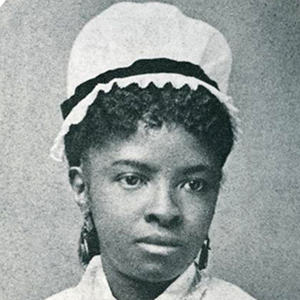
Born in 1831, Dr. Rebecca Lee Crumpler was introduced to medicine by caring for her family and friends.1 As she grew older, she became a nurse and then went on to attend the New England Female Medical College in 1864. Dr. Crumpler was the school’s first and only Black graduate (the school closed in 1873).2 After graduating from medical school in 1864 and becoming a doctor, Crumpler moved to Richmond with her husband to work with the Freedmen’s Bureau, where she provided medical assistance to newly freed Black Americans.3 In 1883, Dr. Crumpler published her book A Medical Discourse in Two Parts, which focused on medical conditions in women and children.4
Dr. Marie Maynard Daly (1947)
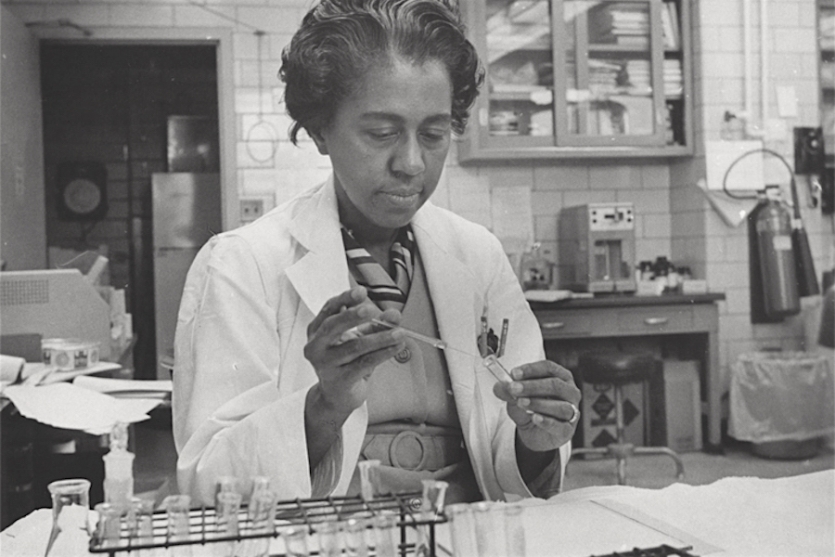
Born in Queens, New York in 1921, Dr. Marie Maynard Daly was encouraged to pursue medicine by her supportive family. She attended Hunter College High School of Women, where she excelled in collegiate-level chemistry classes.5 In 1942, Daly graduated cum laude from Queens College with a degree in chemistry.6 She continued her education and pursued a doctoral degree at Columbia University where she studied how chemicals in the body help with digestion.7 She graduated in 1947, becoming the first Black woman to earn a Ph.D. in chemistry.8 Daly went on to become a professor at Columbia as a professor of biochemistry and medicine. After retiring in 1986, Dr. Daly created a scholarship fund for Black students pursuing physical science at Queens College in 1988.9
Dr. Edith Irby Jones (1952)
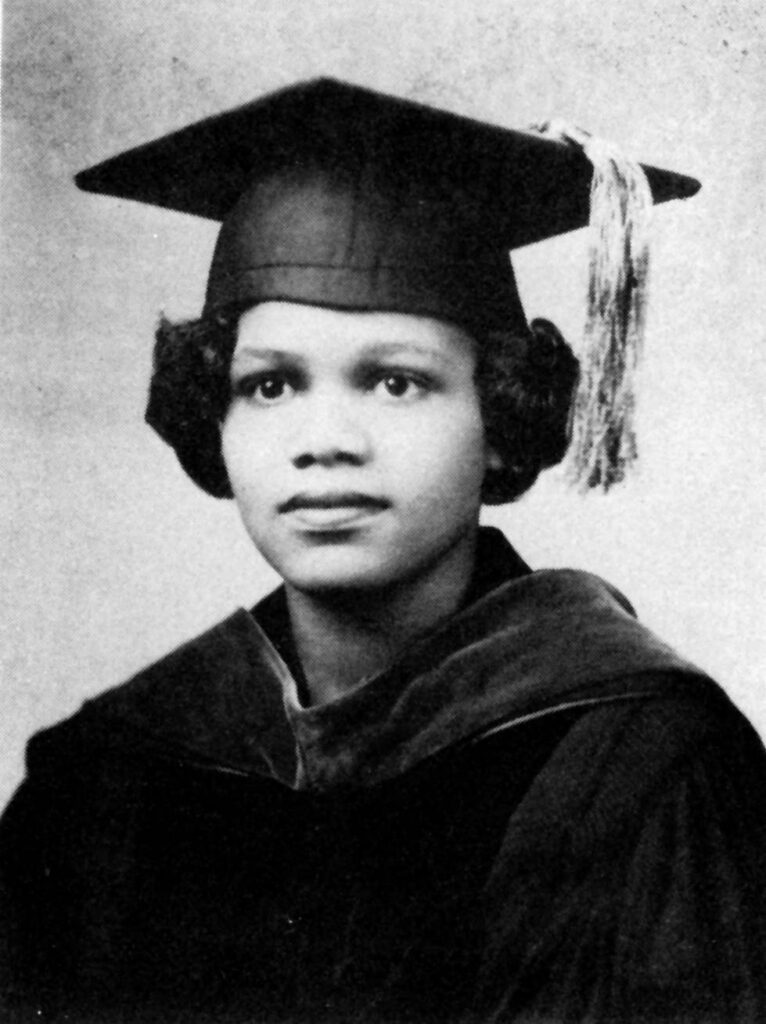
In 1948, Edith Irby Jones was the first Black person admitted into the University of Arkansas. There, she was a student in the MD program while attending school in segregated Arkansas. In 1952, while attending school, Jones became involved with the Civil Rights Movement in Arkansas. She was a part of The Freedom Four, a group that helped spread awareness of the rights of Black people within the United States.10 After graduating from medical school in 1952, Dr. Jones went on to practice medicine at multiple different hospitals and became the first female president of the National Medical Association in 1985.11
Dr. Barbara S. Favazza (1962)

Growing up, Barbara S. Favazza knew she wanted to be in medicine but thought that her only option was to be a nurse. After working in a hospital one summer, Favazza was able to gain valuable experience and was encouraged to go to medical school. Favazza was the first Black woman to graduate from the University of Virginia’s medical school in 1966 and was the only Black student as well as one of just three women in her class.12
Dr. Alexa Canady (1984)
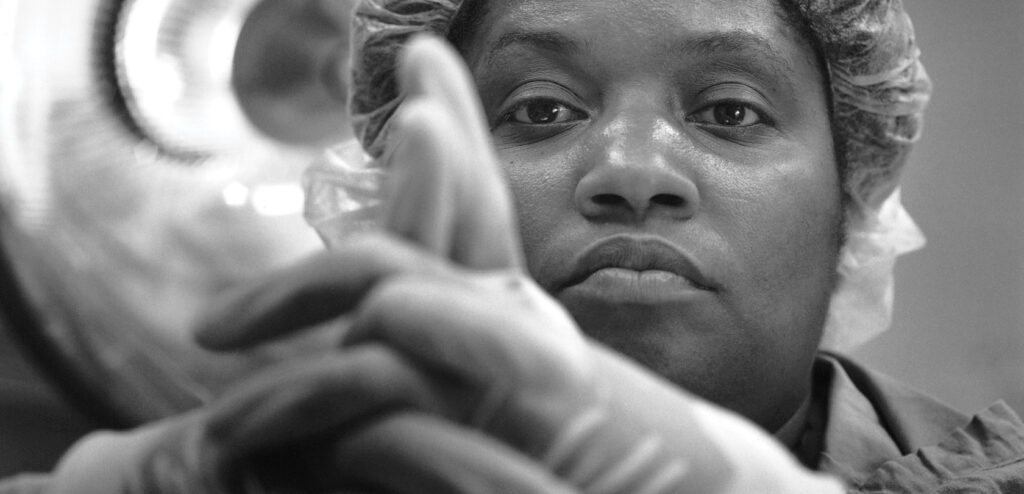
Alexa Canady had extensive education, switching between majors like zoology and mathematics before deciding to pursue medicine. She graduated with a Master’s in Science from the University of Michigan College of Medicine in 1975. After graduating, Canady joined a neurosurgery residency at the University of Minnesota.13 In 1984, Canady became the first African American woman to be certified by the American Board of Neurological Surgery. She found her calling in Pediatric Neuroscience at the Children’s Hospital of Michigan, where she practiced until 1997.
Dr. Joycelyn Elders (1993)
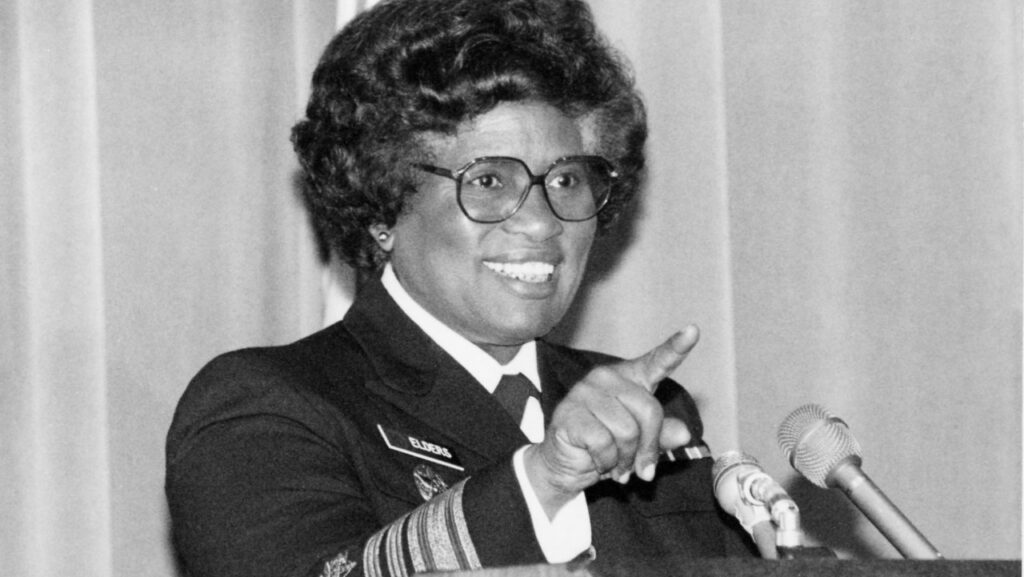
After hearing a speech given by Dr. Edith Irby Jones, Joycelyn Elders was inspired to pursue medicine. After graduating from the College of Philander Smith with a degree in biology, Elders enlisted in the United States Army as a physical therapist.14 She went on to do great work within the Arkansas Department of Health and it would eventually lead to President Bill Clinton selecting her to become the Surgeon General in 1993, making her the first Black woman to be selected for the position.15 She held views on medicine that were seen as controversial to conservatives at the time and they would eventually lead President Clinton to ask her to step down from being Surgeon General.16 Despite these hardships, Elders continued to practice as a pediatric endocrinologist and gave lectures concerning the controversies in the United States’ healthcare system.17
Footnotes
- Barbara Harris, “The Black Woman Who Changed the Face of Medicine.” Jackson Advocate, October 2009. https://umw.idm.oclc.org/login?url=https://www-proquestcom.umw.idm.oclc.org/newspapers/black-woman-who-changed-facemedicine/docview/435318520/se-2?accountid=12299.
- Howard Markel, “Celebrating Rebecca Lee Crumpler, First African American Woman Physician.” PBS NewsHour. March 9, 2016. Celebrating Rebecca Lee Crumpler, first African-American woman physician | PBS NewsHour
- “Titans of Science,” US Black Engineer and Information Technology, Winter, 2013, 90-91, https://umw.idm.oclc.org/login?url=https://www-proquestcom.umw.idm.oclc.org/magazines/titans-science/docview/1476213197/se2?accountid=12299.
- Jaclyn Long, “Rebecca Lee Crumpler: Physician, Author, Pioneer,” Science in the News, December 24, 2020, https://sitn.hms.harvard.edu/flash/2020/rebecca-lee-crumpler-physician-author-pioneer/.
- Rose K. Rose et al., Women in Chemistry and Physics: A Bibliographic Sourcebook, (Westport, CT: Greenwood Press, 1993), 145.
- Jeannette Brown, African American Women Chemists, (Oxford University Press, Incorporated, 2011), 35, accessed February 20, 2021. http://ebookcentral.proquest.com/lib/umw/detail.action?docID=797741
- Rose K. Rose et al., Women in Chemistry and Physics: A Bibliographic Sourcebook, (Westport, CT: Greenwood Press, 1993), 146.
- Wini Warren, Black Women Scientists in the United States. (Bloomington, IN: Indiana University Press, 1999), 72.
- Rose, Women in Chemistry, 148.
- Rebecca Wallersteiner, “Edith Irby jones: Broke through racial barriers to ensure poor patients got the best possible care.” The BMJ (2019), accessed April 14, 2022, https://doi.org/10.1136/bmj.l5117.
- “Dr. Edith Irby Jones,” Arkansas Women’s Hall of Fame, accessed April 14, 2022, https://www.arwomenshalloffame.com/edith-jones .
- Maurice Apprey and Shellie M. Poe, The Key to the Door: Experiences of Early African American Students at the University of Virginia (Charlottesville: University of Virginia Press, 2017), 111-18.
- “Changing the Face of Medicine: Alexa Irene Canady,” U.S. National Library of Medicine (National Institutes of Health, June 3, 2015), https://cfmedicine.nlm.nih.gov/physicians/biography_53.html.
- “Changing the Face of Medicine: Alexa Irene Canady.”
- Kit Moser, Steven Otfinoski, Ray Spangenburg, African Americans in Science, Math, Invention. (City, State? Facts on File, 2011). 67-9
- Julie Von Bergen, Joycelyn Elders, (N.p.: Great Neck Publishing, 2005), 1.
- Jocelyn M. Elders, “Role of Endocrinologists in eliminating health care disparities,” Endocrine Practice: Official Journal of the American College of Endocrinology and the American Association of Clinical Endocrinologists 15, no. 6 (2009): 612-623; “Joycelyn Elders: address at Butler University,” Filmed 2004 at Butler University, IN, video; Frankel, David H, Surgeon General Joycelyn Elders. (London: The Lancet, 1994), 2.